
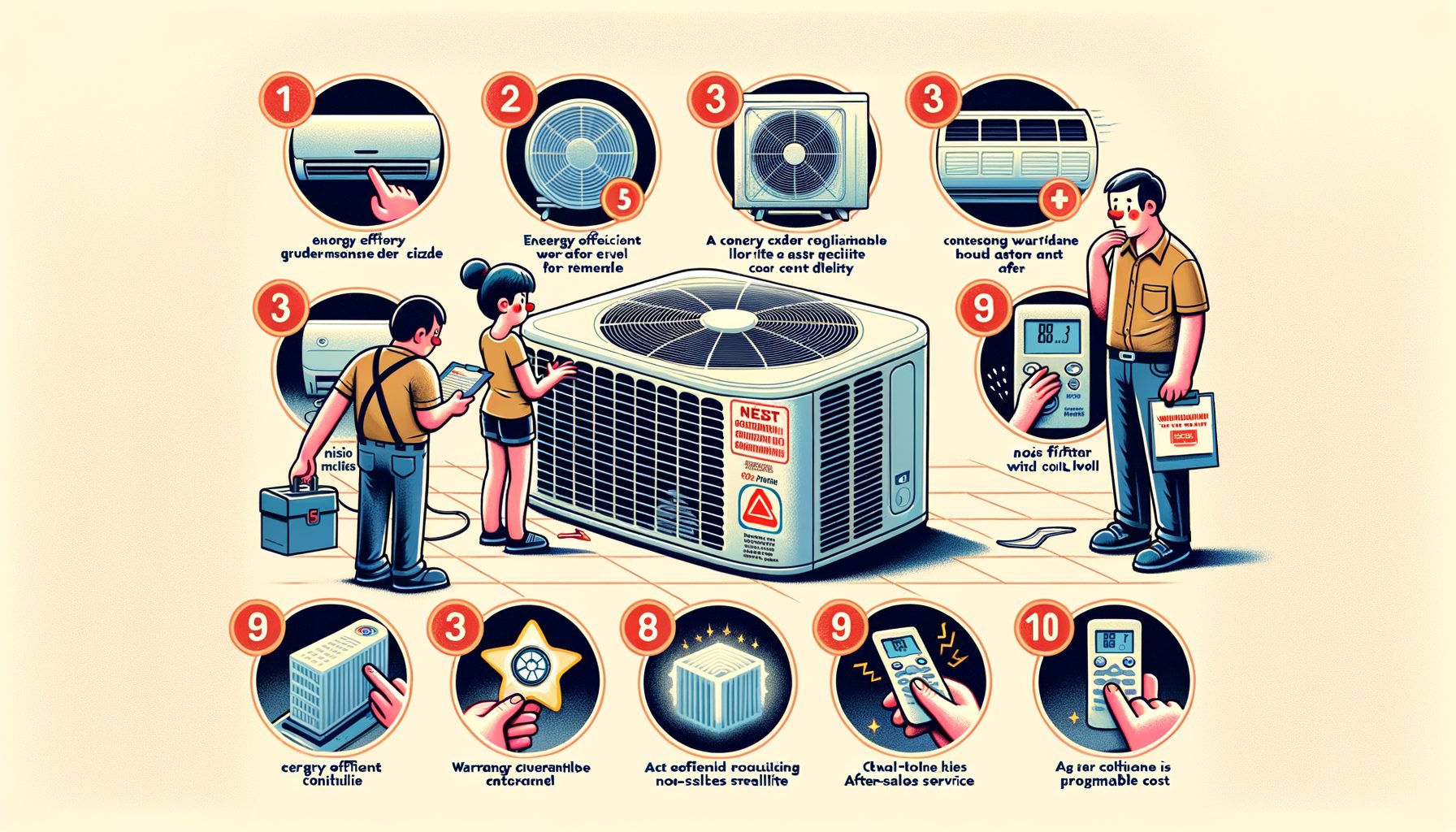
Shopping for your next air conditioner shouldn’t feel like guesswork, yet plenty of buyers end up with units that are too small, too loud, or too costly to run. The real hurdle is clarity: specs like BTU, SEER, inverters, and refrigerants get confusing fast. Here’s a guide that distills everything into 10 essential checks before you buy, so you get a cooler home, lower bills, and fewer surprises. Stick with me—by the end, you’ll know exactly what to look for and how to compare models anywhere.
Check 1–3: Size It Right and Choose Real Efficiency (Capacity, SEER/EER, Inverter)
Begin with the fundamentals: the right size and real efficiency. Capacity is typically listed in BTU/h or kW (1 kW ≈ 3,412 BTU/h). When a unit is undersized, it runs constantly, struggles to cool, and wears out faster. Go too big and it short‑cycles, wastes energy, and won’t dehumidify well. A simple room-size estimate gets you close, yet climate, insulation, sun exposure, and occupancy all influence the load. As a quick rule for moderate climates: 60–80 W per square meter (5–7 W/ft²) of conditioned space; then adjust for your reality (e.g., +10–20% for top floors or large west-facing windows).
To calibrate expectations, refer to the general table below (for a typical bedroom/living space with average insulation). Always validate against local climate and manufacturer guidance.
| Room Size | Approx. Area | Recommended Capacity |
|---|---|---|
| Small bedroom | 10–15 m² (110–160 ft²) | 2.0–2.6 kW (7,000–9,000 BTU/h) |
| Medium room | 16–25 m² (170–270 ft²) | 2.6–3.5 kW (9,000–12,000 BTU/h) |
| Large living space | 26–40 m² (280–430 ft²) | 3.5–5.2 kW (12,000–18,000 BTU/h) |
| Open-plan or high sun gain | 40–60 m² (430–650 ft²) | 5.2–7.0 kW (18,000–24,000+ BTU/h) |
Now turn to real efficiency. In North America, seasonal ratings are SEER2/CEER; many Asian markets list CSPF or EER; in Europe, look for A+++ to G labels with SEER/SCOP. Higher numbers mean less energy per unit of cooling. A quick cost check: annual kWh ≈ (capacity BTU/h ÷ SEER or SEER2) × cooling hours ÷ 1,000. If you run a 12,000 BTU/h unit 600 hours per year, SEER2 20 uses about 360 kWh; SEER2 15 uses ~480 kWh. At $0.25/kWh, that’s $30/year saved—every year.
To round out the fundamentals, decide between an inverter and a fixed-speed compressor. Inverter ACs modulate output to match the load, typically saving 20–40% energy, improving comfort (fewer temperature swings), and reducing noise. In field audits conducted for mixed-climate homes, well-sized inverter mini-splits consistently outperformed similar fixed-speed units, especially during shoulder seasons when loads shift hour to hour. If the budget allows, an inverter is almost always the smarter long-term choice.
Helpful resources: regional energy labels and explanations at ENERGY STAR and the EU’s Energy Label page.
Check 4–6: Installation Fit, Power Requirements, and Noise You Can Live With
Even a highly efficient AC can disappoint if installed poorly or mismatched with your home’s electrical setup. First choose the type: window units are affordable and quick to install but can be loud; portable units are flexible yet often the least efficient (single-hose models can pull hot air indoors). Ductless mini-splits (single or multi-zone) deliver excellent efficiency, zoning, and quiet operation. Ducted systems shine for whole-home comfort but demand quality ductwork and professional design. Renters usually favor window or portable units that are reversible and landlord-friendly; homeowners often find a mini-split balances comfort and lifetime cost best.
Electrical and space checks are non-negotiable. Verify voltage (e.g., 110–120V vs 220–240V), breaker size, and plug type. Some 18,000+ BTU/h units require dedicated circuits. For mini-splits, check line-set lengths and maximum height differences; exceeding manufacturer limits can reduce performance or void warranties. Confirm wall and window dimensions, clearances for airflow, and condensate drainage options. Many poor-performance complaints trace back to simple placement issues: blocked coils, cramped corners, or sun-baked west walls without shading.
Noise matters more than most buyers realize. Indoor sound levels under 40 dB(A) on low fan feel library-quiet; 45–50 dB(A) is a gentle hum; 55+ dB(A) can intrude on sleep. Outdoor units typically range from 45–60 dB(A) at one meter. If you’re in a dense urban area or close to neighbors, check outdoor sound ratings and consider vibration pads. As the World Health Organization notes, sustained noise affects sleep and well-being; a quieter system isn’t just a luxury—it’s a health upgrade. Pro tip: choose models with multi-stage fans and sleep modes; users who drop the night fan speed often report better rest, even with a slightly higher setpoint.
Plan for a quality install. For mini-splits and central systems, proper refrigerant charging, vacuuming, and leak testing are crucial. Ask the installer whether they follow manufacturer commissioning steps and pressure-test line sets. Look up model numbers in the AHRI Directory to confirm matched component performance where applicable (common in North America).
Check 7–9: Air Quality, Humidity Control, and Smart Features That Actually Help
Cooling is only part of comfort. Good air matters. Start with filtration: many ACs include washable filters for dust, while higher-performance options target PM2.5, pollen, and smoke. Check support for MERV-rated filters (in ducted systems) or enhanced filters in mini-splits. True HEPA is rare in standard ACs, but some systems add electrostatic or activated carbon layers for odors and VOCs. If you live in a wildfire or high-pollution region, pairing the AC with a separate HEPA air purifier may be the best approach. The International Energy Agency highlights rising global demand for cooling; combining efficient cooling with clean air is becoming a core home strategy, not a bonus.
Humidity control deserves equal attention. A well-sized, inverter-driven AC usually dehumidifies better by running longer at lower power, pulling more moisture from the air. Look for a dehumidification rate in liters/hour (or pints/hour) and features like “dry mode.” In tropical or coastal climates, prioritize models with strong latent performance and corrosion-resistant coils (e.g., blue-fin coatings). Aim for 40–60% relative humidity indoors to curb mold and keep you comfortable at slightly higher temperatures—saving energy without sacrificing feel.
Smart features have matured beyond gimmicks. Useful ones include:
- Wi‑Fi app control to schedule, change modes, or pre-cool before you arrive.
- Geofencing that turns the unit off when you leave and back on when you return.
- Adaptive or AI modes that learn your preferred comfort patterns.
- Open standards (e.g., Matter) and compatibility with voice assistants to keep your setup flexible.
That said, reliability beats novelty. Read customer reviews about app stability and firmware updates. In my consultations, owners loved smart scheduling and simple energy reports, yet grew frustrated with apps that frequently disconnect. If your Wi‑Fi is spotty, consider units with robust local controls and a physical weekly timer. And if energy prices are high where you live, choose models with built-in energy monitoring so you can see the direct impact of settings like Eco mode or higher setpoints (try 25–27°C / 77–81°F with a fan for big savings).
Check 10: Total Cost, Climate Impact, and Real-World Support (Warranty, Service)
Sticker price is only part of the story. Total cost of ownership includes energy use, maintenance, filters, potential repairs, and even resale value. A quick energy math shortcut: Annual cost ≈ (capacity BTU/h ÷ SEER or SEER2) × hours × electricity price ÷ 1,000. Example: 12,000 BTU/h, 700 hours, $0.30/kWh—SEER2 20 ≈ $126/year; SEER2 15 ≈ $168/year. Over 10 years, that’s a ~$420 difference—often enough to justify stepping up a tier. Also check for government rebates or utility incentives that reward high efficiency or low-GWP refrigerants; these can be substantial. See local programs via U.S. DOE or your national energy agency.
Climate impact matters, too. Many ACs use R32 or R410A refrigerants; R32 has a lower global warming potential (GWP) than R410A and is common in newer models. Emerging options like R290 (propane) or R454B further reduce GWP but may have specific installation rules. Ask your installer about leak prevention practices and certified recovery. Choosing an efficient model with a lower-GWP refrigerant and good longevity remains one of the most climate-positive tech choices you can make at home.
As you wrap up, don’t skip warranty and service. Look for at least 5 years on parts and 7–10 years on compressors for mini-splits and central systems; window units often have shorter coverage. Confirm that authorized service is available in your area and that parts are locally stocked—this can make the difference between a one-day fix and a month-long wait in peak summer. Read the fine print: some warranties require professional installation, registration within a time window, and periodic maintenance. From field experience, brands with strong local distributor networks deliver faster support and better long-term satisfaction than “no-name” imports, even when the specs look similar on paper. When in doubt, check model numbers for third-party performance listings (like AHRI) and scan owner forums for real-world reliability feedback.
FAQs
Q: How do I quickly estimate the right AC size for my room?
A: Multiply your room area by 60–80 W/m² (5–7 W/ft²) as a starting point, then adjust for sun exposure, ceiling height, people, and devices. Use the table above for a quick range, and prioritize an inverter model for better real-world comfort across varying loads.
Q: Is an inverter AC worth the extra cost?
A: In most cases, yes. Inverters can save 20–40% energy, maintain steadier temperatures, and run quieter. If you use your AC many hours per day or pay high electricity rates, the payback can arrive within a few seasons.
Q: What’s the difference between SEER, SEER2, EER, and CEER?
A: All are efficiency metrics but measured differently. SEER/SEER2 are seasonal ratings for split systems (SEER2 uses revised test procedures). EER is a steady-state rating at specific conditions. CEER applies to room/window units. Compare models using the rating standard common in your country.
Q: How important is noise in choosing an AC?
A: Very. For bedrooms, aim for indoor noise under ~40 dB(A) on low. Quiet systems improve sleep and perceived comfort. Check both indoor and outdoor dB ratings and look for sleep modes and multi-speed fans.
Conclusion: Turn Specs into Comfort—Make the Next Summer Your Easiest Yet
You’ve just walked through the 10 essential checks that separate a “meh” air conditioner from a great one: right-sized capacity, verified efficiency (SEER/SEER2/EER), inverter technology, installation fit, electrical and space needs, quiet operation, clean air and humidity control, truly useful smart features, total cost and climate impact, and solid warranty with local support. Together, they form a clear map from spec sheet to real comfort—without blowing your budget.
Here’s your action plan: measure your room and shortlist the capacity range; choose a type (window, portable, mini-split, or ducted) based on your home and whether you rent or own; prioritize an inverter model with a strong seasonal efficiency rating; confirm electrical compatibility and noise levels; check for IAQ features and humidity performance relevant to your climate; and finish by comparing total cost of ownership, refrigerant choice, and warranty terms. If possible, talk to a certified installer and ask them to validate your sizing and placement—getting those right multiplies the value of every other decision.
Don’t wait until the first heatwave. Models sell out, installers get booked, and you lose the chance to optimize. Start your shortlist today, price-compare smartly, and look for rebates or incentives in your region. If you’re balancing options, test-drive the comfort settings: try a slightly higher setpoint (25–27°C / 77–81°F) with a ceiling or pedestal fan, use smart scheduling, and leverage “dry mode” in humid weather—you’ll feel better and spend less.
Your next AC can be more than a cold blast—it can be a quiet, efficient, climate-savvy system that makes your home feel right all year. Ready to make cooling simple, smart, and sustainable? Pick your top three candidates now and check them against the 10 points above. What’s the one feature you won’t compromise on this time?
Sources