
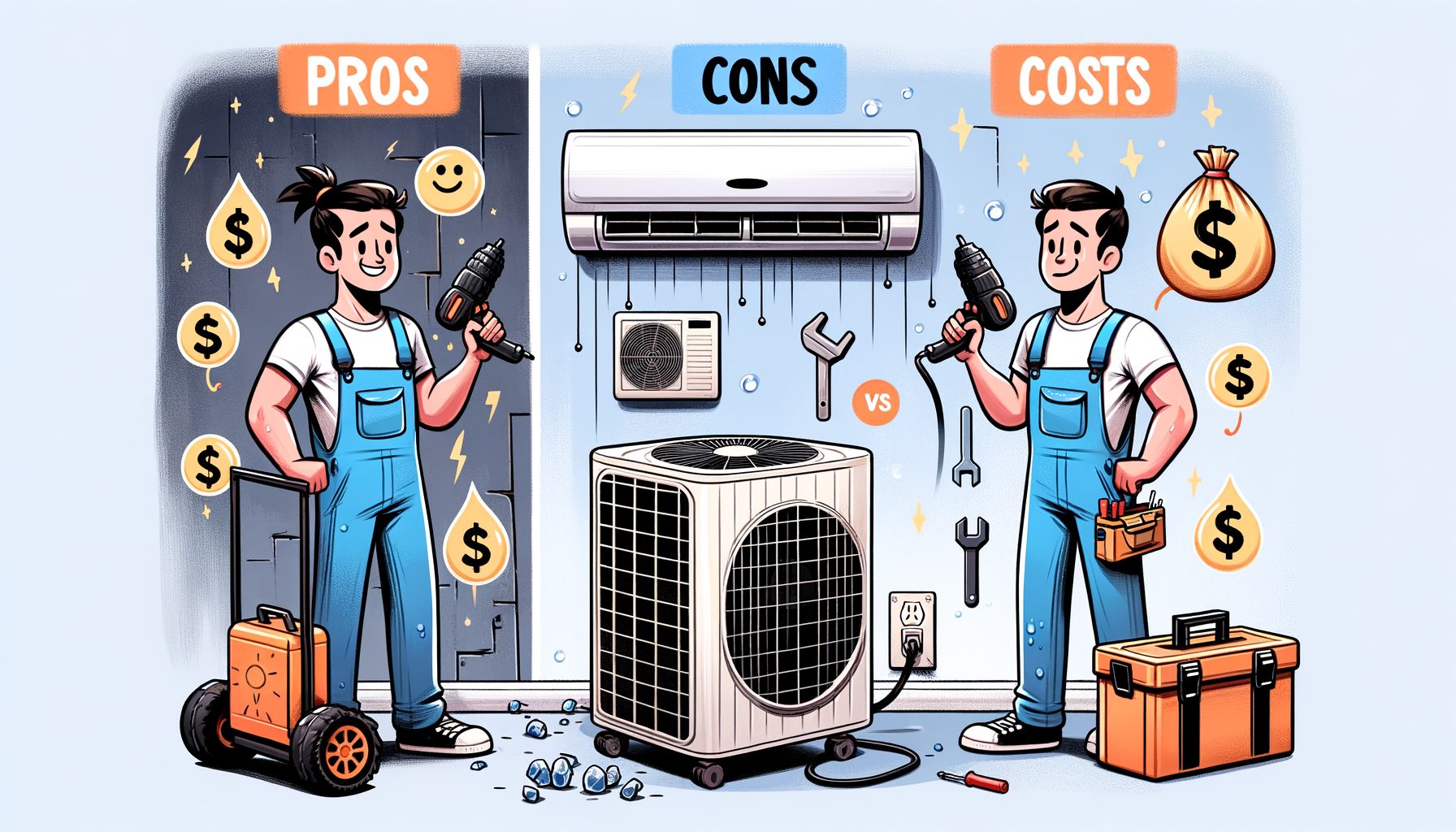
Choosing how to cool your space shouldn’t feel like a coin toss. Yet for many people, the Portable AC vs Split AC decision is confusing: both promise quick relief, but costs, performance, and everyday comfort can vary a lot. If you’ve ever wondered which one cools better, which one is cheaper over time, or which suits renters versus homeowners, you’ll find clear comparisons, real numbers, and practical buying tips you can use today.
Portable AC vs Split AC: What’s the Real Difference?
At a glance, both options cool a room, yet they’re built in very different ways. A portable AC is a single unit that sits on the floor and vents hot air out a window via a hose (single-hose or dual-hose). Roll it in, attach the window kit, plug it in, and you’re mostly done. It’s that simplicity that makes portable ACs popular with renters, students, and anyone who needs fast, temporary cooling. There’s a catch, though: single-hose models can pull warm, unfiltered air into the room from other parts of your home, which lowers efficiency. Dual-hose designs curb the issue by using one hose to bring in outside air for the condenser and another to exhaust hot air.
A split AC (often called a mini-split or ductless AC) separates the noisy, heat-rejecting components into an outdoor unit and keeps a quiet air handler indoors. Many systems use inverter technology to modulate power smoothly, delivering steady cooling with less energy waste. As a result, you get better efficiency, quieter operation, and improved comfort—especially in hot climates or larger rooms. Installation, however, is handled by a professional: the indoor unit is mounted, a small wall hole is drilled for refrigerant lines, and the outdoor unit is placed safely and legally.
Space and aesthetics differ, too. Portable ACs occupy floor area and need a visible hose in the window. Split ACs free up floor space, but you’ll see a wall-mounted indoor unit and an outdoor unit on a wall or pad. What’s interesting too: noise feels different. Portable ACs keep the compressor inside the room, so you’ll hear it; split systems move most noise outdoors, creating a calmer indoor environment. In terms of durability, split ACs generally last longer with proper maintenance, while portable units are convenient but often less robust across many seasons.
Well, here it is: choose portable if you need flexible, low-commitment cooling with minimal install. Choose split if you want higher efficiency, quieter comfort, and you’re okay with a one-time installation that pays off over time.
Cooling Performance and Energy Efficiency Explained
Performance starts with sizing. Cooling capacity is measured in BTU/h. As a rule of thumb, 12,000 BTU/h (often called “1 ton” in some regions) can cool roughly 20–42 m² (215–450 ft²) depending on ceiling height, insulation, window exposure, and climate. Undersizing makes any AC run nonstop and struggle in heat waves; oversizing can short-cycle, wasting energy and leaving the room humid. A reputable sizing calculator or a local professional should account for your room’s orientation, sun exposure, occupancy, and electronics.
Efficiency metrics differ by product type. Portable ACs often list CEER (Combined Energy Efficiency Ratio) or EER; mini-splits often list SEER (Seasonal Energy Efficiency Ratio) and sometimes HSPF for heating. Higher numbers generally mean better efficiency. Typical ranges: portable AC CEER/EER about 6–10; window units around 10–12; modern mini-splits often SEER 18–25+ with equivalent EERs commonly in the 10–15 range. Because split systems use inverter compressors, output is modulated and they frequently operate at partial load, where real-world efficiency can exceed what maximum ratings suggest.
Then this: the single-hose issue matters. A single-hose portable draws room air across its condenser and exhausts it outside. That exhaust creates negative pressure, pulling warm, humid air from nearby spaces into the cooled room. Net cooling can drop and energy use can rise. Dual-hose models mitigate the loss by separating intake and exhaust paths, improving real-world performance. If you must buy a portable unit, a dual-hose model is worth the extra cost.
Climate and humidity play a big role. In very humid climates, ACs must remove moisture (latent load) as well as heat (sensible load). Split systems generally handle dehumidification more consistently due to slower, steady operation. Portable units remove moisture, too, but may require draining or a continuous drain hose; some also auto-evaporate condensate. What’s interesting too: balanced humidity (often 40–60% relative humidity) improves comfort and can reduce the need for extreme cooling; for general humidity guidance, see resources from public health authorities such as the WHO and building standards organizations like ASHRAE.
Noise and airflow affect perceived performance. Many portable ACs run at 50–65 dB in the room; mini-split indoor units can operate as low as ~19–40 dB because the compressor sits outside. Even airflow matters: split units distribute air higher on the wall, often providing better circulation and fewer hot spots. Bottom line: for sustained comfort and lower energy bills, split systems generally deliver more cooling per kWh, especially in tough climates, while portable ACs offer workable relief when installation limits apply.
Costs: Upfront, Running, and Hidden
Well, here it is: total cost of ownership matters more than sticker price. Portable ACs have lower upfront costs and near-zero installation fees. Split ACs cost more to buy and install but can save money month-to-month thanks to better efficiency. Consider not just purchase price, but also installation, electricity, maintenance, and any landlord rules or homeowner association constraints.
Here are typical ranges and reference values (actual prices vary by region and brand):
| Factor | Portable AC | Split AC (Mini-Split) |
|---|---|---|
| Typical equipment cost | US$250–700 (dual-hose often higher) | US$800–2,500 per indoor zone |
| Installation cost | US$0–100 (DIY window kit) | US$1,200–3,500+ (professional install) |
| Efficiency (typical) | CEER/EER ~6–10 | SEER ~18–25+ (EER often ~10–15) |
| Indoor noise | ~50–65 dB | ~19–40 dB (compressor outside) |
| Expected lifespan | ~5–10 years | ~10–15+ years with maintenance |
To estimate power cost, try a quick method: Watts = BTU/h ÷ EER. For example, a 12,000 BTU portable AC with EER 7 uses roughly 1,714 W (1.714 kW). If it runs for 6 hours at a grid rate of US$0.15/kWh, that’s 1.714 × 6 × 0.15 ≈ US$1.54 per day. Over a 30-day month, about US$46. A comparable 12,000 BTU split with an effective EER near 12 might draw ~1,000 W at full output, but often less due to inverter modulation. If it averages 0.7 kW over 6 hours, the cost is 0.7 × 6 × 0.15 ≈ US$0.63 per day, or about US$19 per month—less than half the portable in this example.
Then this: poor window sealing on a portable AC can leak hot air back in; investing in better foam seals or a dual-hose model can reduce losses. For split systems, improper installation (kinked linesets, low refrigerant charge, poor condensate routing) can hurt efficiency and reliability; always use certified professionals and follow local codes. Maintenance also matters: dirty filters and coils increase energy use for both types. In power-constrained regions or where electricity prices are rising, the efficiency of a split system can quickly offset upfront costs. For energy benchmarks and ways to compare models, review guidance from ENERGY STAR and your local energy authority; for a global perspective on cooling demand and efficiency, see the International Energy Agency’s analysis of the future of cooling at the IEA.
Buying Tips: How to Choose the Best AC for Your Space
Start with your living situation and constraints. Renting an apartment, moving soon, or unable to mount an outdoor unit? A portable AC—ideally dual-hose—may be the best immediate fit. Owning your home, planning to stay, and facing long hot seasons? A split AC provides quieter comfort, stronger humidity control, and lower bills over time. If one can be installed, the long-term experience usually wins.
Next, size it right. Calculate the BTU/h needed by room area and conditions. If your room is sun-baked, has poor insulation, high ceilings, or lots of electronics, bump the estimate. If you’re unsure, get a professional load calculation. Many energy organizations offer free calculators; local utilities often provide guidance similar to the U.S. Department of Energy’s Energy Saver pages and the UK’s Energy Saving Trust resources.
For portable ACs, choose dual-hose when possible, and ensure the window insert seals tightly. Check CEER/EER, noise levels, and drainage options (auto-evaporation vs drain). Look for washable filters and, if you’re sensitive to sound, compare decibel ratings. Smart features can help: Wi‑Fi scheduling and geofencing reduce wasted runtime. For split systems, prioritize inverter models with high SEER, strong warranties, and reputable installer support. Make sure the indoor unit placement allows good airflow across the room; avoid obstructions and heat sources. If heating is relevant, a heat-pump mini-split can serve all year, often far more efficiently than resistance heaters.
Consider total comfort, not just temperature. Indoor noise affects sleep and focus; here, split systems have a clear edge. Humidity control matters, too; an oversized or non-inverter unit might cool quickly but leave the air clammy. In dusty or polluted environments, filter quality and easy access for cleaning are big wins. Maintenance should be simple: both types need regular filter cleaning, but mini-splits benefit from periodic pro service to keep coils and blower clean.
Finally, think about environmental impact. Higher efficiency means fewer emissions over the product’s lifetime. Many modern systems use refrigerants like R-32 (lower global warming potential than older R-410A). Proper installation and end-of-life recovery of refrigerant are essential for both. If you’re curious about policy and global trends, the IEA’s work on sustainable cooling is a useful reference, as are standards from organizations like ASHRAE.
FAQ: Portable AC vs Split AC
Q: Which cools faster, a portable AC or a split AC?
A: In similar sizes, a well-installed split AC usually cools more effectively and maintains comfort better, thanks to higher efficiency and better airflow. Portable units deliver quick relief but may struggle in larger rooms or very humid climates.
Q: Is a dual-hose portable AC really better?
A: Yes. Dual-hose designs reduce negative pressure and improve net cooling, especially in tight or hot spaces. If you need a portable unit, dual-hose is typically worth the upgrade.
Q: How do I estimate my monthly cost?
A: Use Watts = BTU/h ÷ EER, then multiply by hours used and your local kWh price. With inverter split systems, average power can be lower than the full-load estimate because output is modulated.
Q: Can a mini-split also heat my home?
A: Many mini-splits are heat pumps and can heat efficiently, even in cool climates. Check the HSPF or SCOP rating and low-ambient performance if winters are cold in your area.
Q: I’m a renter. Is a split AC possible?
A: It depends on your lease and local rules. Many renters opt for portable units due to minimal installation. If you want a split, get written approval from your landlord and ensure a professional installation.
Conclusion: Make the Right Cooling Choice and Start Saving Today
If you came here to settle the Portable AC vs Split AC debate, here’s the bottom line: portable ACs win on simplicity, mobility, and low upfront cost; split ACs win on efficiency, quiet operation, and long-term comfort. For renters, students, and short-term setups, a dual-hose portable AC can be a smart, flexible fix. For homeowners and anyone facing long, hot seasons, a well-installed split system is a long-term upgrade that typically pays you back in lower energy bills, better sleep, and more stable indoor comfort.
Across performance, efficiency, and daily living, the split AC is often the higher-impact investment. It cools more consistently, removes humidity more effectively, and keeps noise low so you can focus, rest, or create without distractions. Upfront cost is higher, but running cost is usually much lower. In many regions, the monthly savings compared to a portable AC add up fast—especially as global cooling demand grows. If installation is possible in your space, talk to a qualified installer, request a proper load calculation, and check incentive programs or rebates from your utility or government. These can significantly offset your initial expense.
If a split system isn’t an option, don’t worry: you can still optimize a portable AC. Choose a dual-hose model, seal the window kit carefully, close doors and blinds during peak sun, clean filters regularly, and use smart scheduling to cool only when needed. Combined with small steps—like adding shade, improving insulation, and using a ceiling fan—you can boost comfort without overworking your unit.
Ready to act? Pick the path that fits your life. If you need instant, flexible cooling, shortlist two or three dual‑hose portable models and compare their CEER, noise, and user reviews today. If you’re investing for the long haul, get quotes from licensed installers for a high‑SEER mini‑split and ask about rebates and warranties. In both cases, right-sizing and good setup are your secret weapons. Start now, stay cool sooner, and keep more money in your pocket over the season.
Comfort is a choice, and you can make a smart one today. What’s the one step you’ll take right now to make your space cooler, quieter, and more efficient?
Sources
International Energy Agency: The Future of Cooling
ENERGY STAR: Air Conditioner Guidance and Certifications
U.S. Department of Energy: Energy Saver – Room AC
Energy Saving Trust (UK): Cooling and Energy Advice