
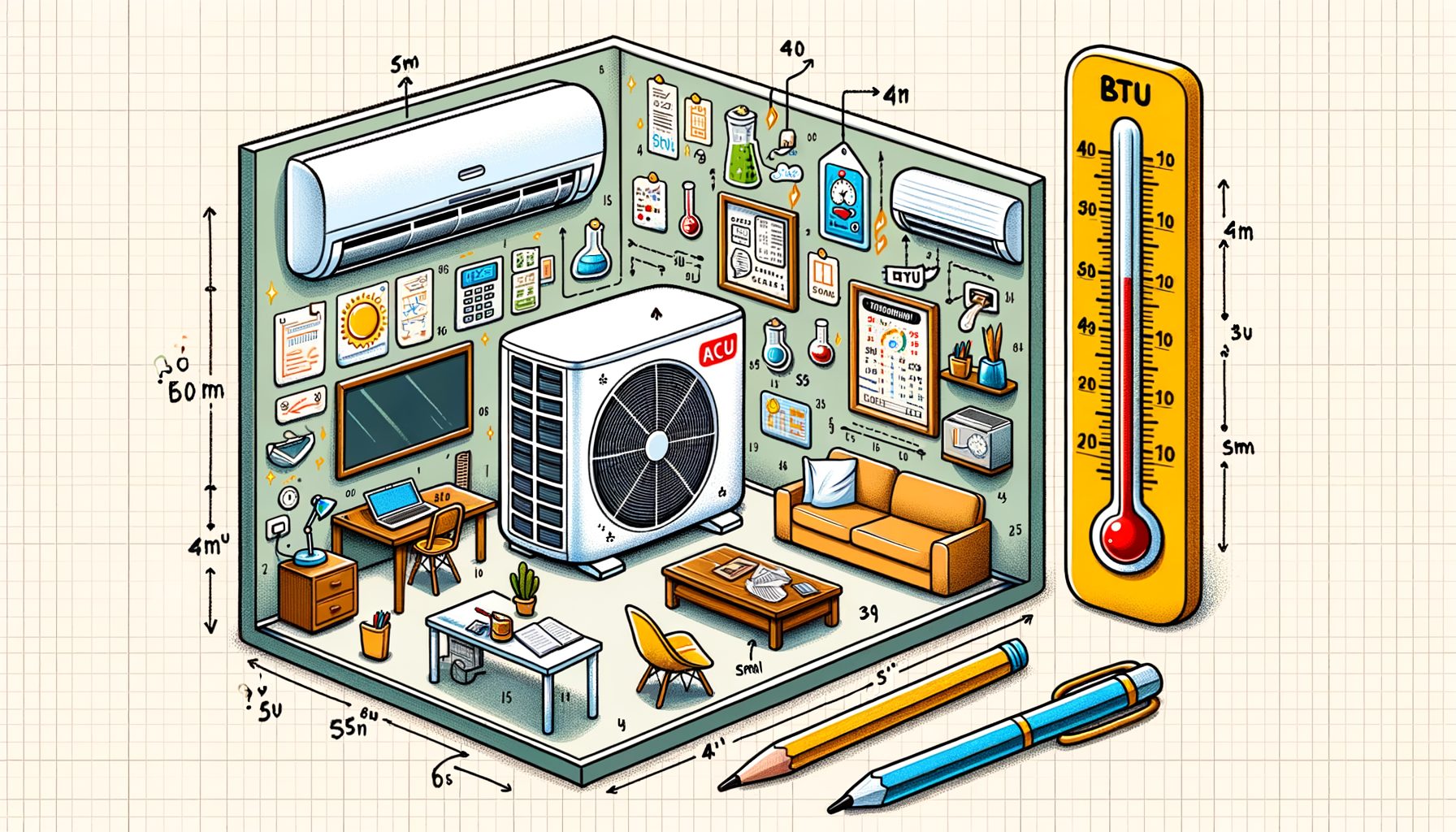
Choosing the right air conditioner capacity is tricky, and the stakes are high. Pick a unit with too few BTUs and your space never feels cool; pick one with too many BTUs and you waste money, deal with clammy air, and shorten equipment life. The guide below explains BTU in plain language, walks you through sizing step by step, and helps you dodge costly mistakes. Want fast comfort, lower bills, and fewer headaches? Understanding BTU and air conditioner capacity is the smartest first move.
Why BTU Matters: The Real Problem With Air Conditioner Capacity
Most people mis-size—buying an AC that is either too small or too large for the room. Under-sized units run nonstop, struggle during heat waves, and fail to remove enough humidity. Over-sized units blast cold air too quickly and then shut off, a behavior called short-cycling. That may sound good at first, but it leaves the air humid, increases mold risk, and uses more energy per hour of actual cooling. You also get uncomfortable temperature swings and more noise.
Sizing also hits your energy bill directly. An air conditioner is essentially a heat pump that moves heat from indoors to outdoors. The more precisely its BTU capacity matches your room’s heat load, the fewer wasted starts and stops you get, and the more efficiently the unit runs. Organizations such as ENERGY STAR emphasize proper sizing because over- or under-capacity can reduce performance and drive up costs. For background, see ENERGY STAR’s guidance on room ACs at https://www.energystar.gov/products/heating_cooling/air_conditioning_room.
Humidity control matters just as much. In humid climates, an over-sized AC may cool the air before it has time to remove moisture. That leads to “cold-and-damp” conditions: windows fog, bedding feels sticky, and your indoor air quality dips. In my field notes from apartment audits in coastal cities, tenants with units oversized by about 30% frequently reported chilly but damp rooms, poor sleep, and musty smells after only one season of use. A right-sized or inverter-driven unit with a dry mode improved comfort within days.
Good sizing also extends equipment life. Compressors and fans are designed for steady operation, not constant on/off cycling. When the BTU rating tracks the actual load closely, mechanical stress is reduced. Add in basic maintenance—clean filters, clear vents—and you get a cooler, quieter space with fewer repairs.
BTU Explained: What It Means, Key Conversions, and Why It Matters
BTU stands for British Thermal Unit. In cooling, BTU per hour (BTU/h) measures how much heat an air conditioner can remove from a room each hour. One BTU is roughly the energy needed to raise 1 pound of water by 1 degree Fahrenheit. For everyday use, think of BTU/h as the “cooling horsepower” of your unit: higher BTU/h means more heat removal capacity.
Helpful conversions:
– 1 BTU/h ≈ 0.293 watts (W)
– 1 kilowatt (kW) ≈ 3,412 BTU/h
– 1 ton of refrigeration = 12,000 BTU/h ≈ 3.517 kW
Manufacturers may list capacity as BTU/h, tons, or kW. For example, a 12,000 BTU/h unit is a 1-ton AC and roughly a 3.5 kW cooling appliance. Portable ACs and window units typically use BTU/h, while ductless mini-splits and central systems may use tons or kW depending on the market.
You’ll also see an efficiency spec, commonly shown as EER (Energy Efficiency Ratio) or SEER (Seasonal Energy Efficiency Ratio). EER is BTU/h divided by watts at a fixed set of conditions. SEER estimates seasonal performance under varying conditions. Higher numbers mean better efficiency. Modern inverter mini-splits can deliver SEER ratings above 20, often beating traditional fixed-speed units on energy savings and comfort. The U.S. Department of Energy has practical information on room AC efficiency at https://www.energy.gov/energysaver/room-air-conditioners.
Why BTU matters: It aligns your AC’s maximum cooling rate with your room’s heat gain (from sun, people, appliances, and leaks). If your space leaks warm air or gets intense afternoon sun, the load increases and you need more BTUs. If your home is well insulated and shaded, you may need fewer. Understanding BTU is about matching capacity to reality. That match is the difference between a system that “just runs” and a system that quietly delivers comfort day after day.
Step-by-Step: Calculate the Right Air Conditioner Capacity for Your Room
Try this quick method to size an AC that fits your space. It blends a baseline rule of thumb with correction factors for ceiling height, sun exposure, occupancy, and special uses like kitchens.
1) Measure your floor area.
– In square feet (ft²): length × width.
– In square meters (m²): length × width.
2) Start with a baseline.
– Typical baseline: about 20 BTU/h per ft² (≈ 65 W/m²).
– Multiply your area by this baseline to get a starting capacity.
3) Adjust for ceiling height.
– Baseline assumes ~8 ft (2.4 m).
– For 9–10 ft (2.7–3.0 m) ceilings, add about 10–25%.
4) Adjust for sun exposure and insulation.
– Very sunny or west-facing, minimal shade: add 10–20%.
– Well-insulated, shaded: you may reduce by 5–10%.
5) Adjust for occupants and heat sources.
– Add ~600 BTU/h (≈ 175 W) per person beyond two in the room.
– For kitchens or rooms with frequent cooking: add 3,000–4,000 BTU/h.
6) Consider climate and usage patterns.
– In very humid climates, avoid heavy oversizing; consider inverter units or models with dedicated dehumidify modes.
– If you routinely keep doors open to adjacent spaces, include that area in your calculation.
Example: A 300 ft² (27.9 m²) sunny living room with a 9 ft ceiling and 3 people.
– Baseline: 300 × 20 = 6,000 BTU/h.
– Ceiling +15%: 6,900 BTU/h.
– Sun +10%: 7,590 BTU/h.
– Occupant adjustment: +600 BTU/h (one extra person) = 8,190 BTU/h.
– Round to the nearest common size: 8,000–9,000 BTU/h. If humidity is high, an inverter at 9,000 BTU/h is often the better pick.
Prefer a quick look-up? The table below aligns with widely used guidance such as ENERGY STAR’s sizing ranges for room ACs. Use it as a starting point, then apply adjustments above. Reference: https://www.energystar.gov/products/heating_cooling/air_conditioning_room.
| Room Area (ft²) | Room Area (m²) | Recommended Capacity (BTU/h) | Approx. kW |
|---|---|---|---|
| 100–150 | 9–14 | 5,000 | 1.47 |
| 150–250 | 14–23 | 6,000 | 1.76 |
| 250–300 | 23–28 | 7,000 | 2.05 |
| 300–350 | 28–33 | 8,000 | 2.35 |
| 350–400 | 33–37 | 9,000 | 2.64 |
| 400–450 | 37–42 | 10,000 | 2.93 |
| 450–550 | 42–51 | 12,000 (1 ton) | 3.52 |
| 550–700 | 51–65 | 14,000 | 4.10 |
| 700–1,000 | 65–93 | 18,000 (1.5 ton) | 5.28 |
Note: These are typical ranges for single rooms with average conditions. Always adjust for ceiling height, sun, occupancy, and special uses. For professional design, contractors use detailed load calculations such as ACCA Manual J or design data in the ASHRAE Handbook (https://www.ashrae.org/technical-resources/ashrae-handbook).
Energy Efficiency, Inverter Technology, and Common Sizing Mistakes
Do BTUs affect your bill? Indirectly, yes. BTU/h is the maximum cooling capacity, not the energy consumption by itself. Your energy use depends on how long and how hard the unit runs to maintain your setpoint. A unit with too few BTUs runs longer at full tilt. A unit with too many BTUs short-cycles and wastes energy during start-up and shutdown. The sweet spot is right-sized capacity with high efficiency (good EER/SEER) and intelligent control.
Inverter vs non-inverter: Inverter ACs vary the compressor speed to match load. Doing so reduces cycling losses, maintains tighter temperature and humidity, and usually lowers energy use, especially in part-load conditions (most of the season). Non-inverter units run at one speed: on or off. In real homes and apartments, an inverter system that is close to the calculated BTU need often delivers the best comfort at the lowest cost over time. For background on seasonal efficiency metrics, see DOE and ENERGY STAR resources at https://www.energy.gov/energysaver and https://www.energystar.gov.
Common mistakes to avoid and how to fix them:
– Ignoring ceiling height: High ceilings increase room volume. Add 10–25% capacity if your ceiling is 9–10 ft (2.7–3.0 m).
– Skipping sun and insulation factors: West-facing glass and weak insulation can add 10–20% load. Use shades, films, or curtains to reduce this before upsizing the AC.
– Overlooking humidity: In humid regions, do not oversize. Choose an inverter with a dry/dehumidify mode and run on a moderate setpoint for better moisture removal.
– Forgetting occupancy and equipment: Add capacity for extra people, gaming PCs, or home offices with multiple monitors. Small devices add up.
– Confusing BTU and efficiency: A 12,000 BTU/h unit with SEER 22 can cost less to operate than a 10,000 BTU/h unit with SEER 12 if both are serving a similar load. Capacity and efficiency are different specs.
– Not maintaining the unit: Dirty filters, blocked coils, and clogged condensate drains ruin performance. Clean filters monthly during heavy use and keep outdoor units clear of debris.
If you are on the fence between two sizes, consider your climate, humidity, and how often you close doors. Inverter systems tolerate slight oversizing better because they can throttle down. For non-inverter window units, closer is better—choose the capacity that matches your adjusted calculation rather than going big “just in case.”
BTU and AC Capacity: Quick Q&A
Q1: Is bigger always better with BTU?
A: No. An over-sized unit cools quickly but does not run long enough to remove moisture. You end up with a cold yet clammy room, higher energy use, and more wear on the equipment. Aim to match the BTU rating to your calculated load, then favor higher efficiency (SEER/EER) and inverter technology when possible.
Q2: What if my room is open to another area?
A: Include the combined area in your calculation, and consider airflow between spaces. If air moves freely, one slightly larger unit might work. If the spaces are separated by partial walls or doors, two smaller units can control comfort better. Ductless multi-splits are a flexible option for open-plan apartments.
Q3: How do I size for very humid climates?
A: Avoid oversizing. Use the baseline calculation, apply only necessary adjustments, and pick an inverter unit with a dry mode. Keep your fan speed moderate during peak humidity to increase moisture removal. A dedicated dehumidifier can help in severe cases, especially in basements.
Q4: Do portable ACs deliver the BTU they advertise?
A: Portable ACs often have lower effective capacity because they can pull warm air into the room and lose efficiency through single-hose designs. Look for SACC (Seasonally Adjusted Cooling Capacity) ratings where available, which better reflect real-world performance. ENERGY STAR and DOE resources explain SACC in more detail.
Q5: When should I call a professional?
A: If your space is complex—vaulted ceilings, large windows, mixed-use rooms, or you are cooling multiple zones—an HVAC professional can run a Manual J load calculation for accurate sizing. Such calculations are standard practice for permanent installations and are supported by design references like the ASHRAE Handbook (https://www.ashrae.org/technical-resources/ashrae-handbook).
Conclusion: From BTU Theory to Everyday Comfort—Act Now
Here is the bottom line: BTU is the language of cooling capacity, and getting it right is the fastest path to true comfort, lower bills, and fewer equipment problems. You now know how BTU relates to real spaces—what it means, how to convert it to kW or tons, and why matching capacity to load matters. You also saw a practical, step-by-step sizing method and a reference table grounded in widely used guidance, plus the key adjustments for ceiling height, sun, occupancy, and special uses. On the efficiency side, you understand why inverter technology and metrics like SEER/EER influence cost and comfort, and how to avoid common sizing mistakes that many buyers make.
Take action today. Measure your room, apply the baseline and adjustments, and choose the nearest capacity that fits your reality. If you are between sizes, prefer the inverter option for flexibility and better humidity control. Cross-check your choice with a reputable source such as ENERGY STAR, and when in doubt—especially for multi-room or complex spaces—get a Manual J-based opinion from a qualified HVAC pro. A few careful decisions now can save you hundreds of dollars in energy and extend the life of your system.
Your next step: grab a tape measure, note your sun exposure, count regular occupants, and use the table and steps from this article to shortlist two models. Compare their efficiency ratings, features, and warranties. Then buy once, install right, and enjoy quiet, steady comfort. Cooling should feel easy—and with the right BTU and capacity, it will.
Every comfortable room starts with a smart choice. What space in your home are you going to optimize first?
Sources:
– ENERGY STAR Room Air Conditioners: https://www.energystar.gov/products/heating_cooling/air_conditioning_room
– U.S. Department of Energy, Energy Saver – Room Air Conditioners: https://www.energy.gov/energysaver/room-air-conditioners
– ASHRAE Handbook (HVAC Fundamentals): https://www.ashrae.org/technical-resources/ashrae-handbook
– WHO Heat and Health guidance: https://www.who.int/news-room/fact-sheets/detail/climate-change-heat-and-health